The ChatGPT Generation: How AI Is Quietly Rewriting the Global Student Search
Goodness knows, international higher education is no stranger to major change. Over the last two decades, rankings, social media, and professionalised agent networks have all fundamentally altered student mobility flows. While much focus is on visa policy, government shifts and emerging capacity in historically outbound markets, a new force is now emerging—quieter, more diffuse, and arguably more transformative—in the form of generative artificial intelligence (AI).
In September 2025, we conducted a cross-institution survey of over 1,600 newly enrolled international students in the US and UK. Our goal was simple: to understand how students are using AI in the crucial, early part of their journey—identifying and applying to university—long before they ever step into a lecture hall.
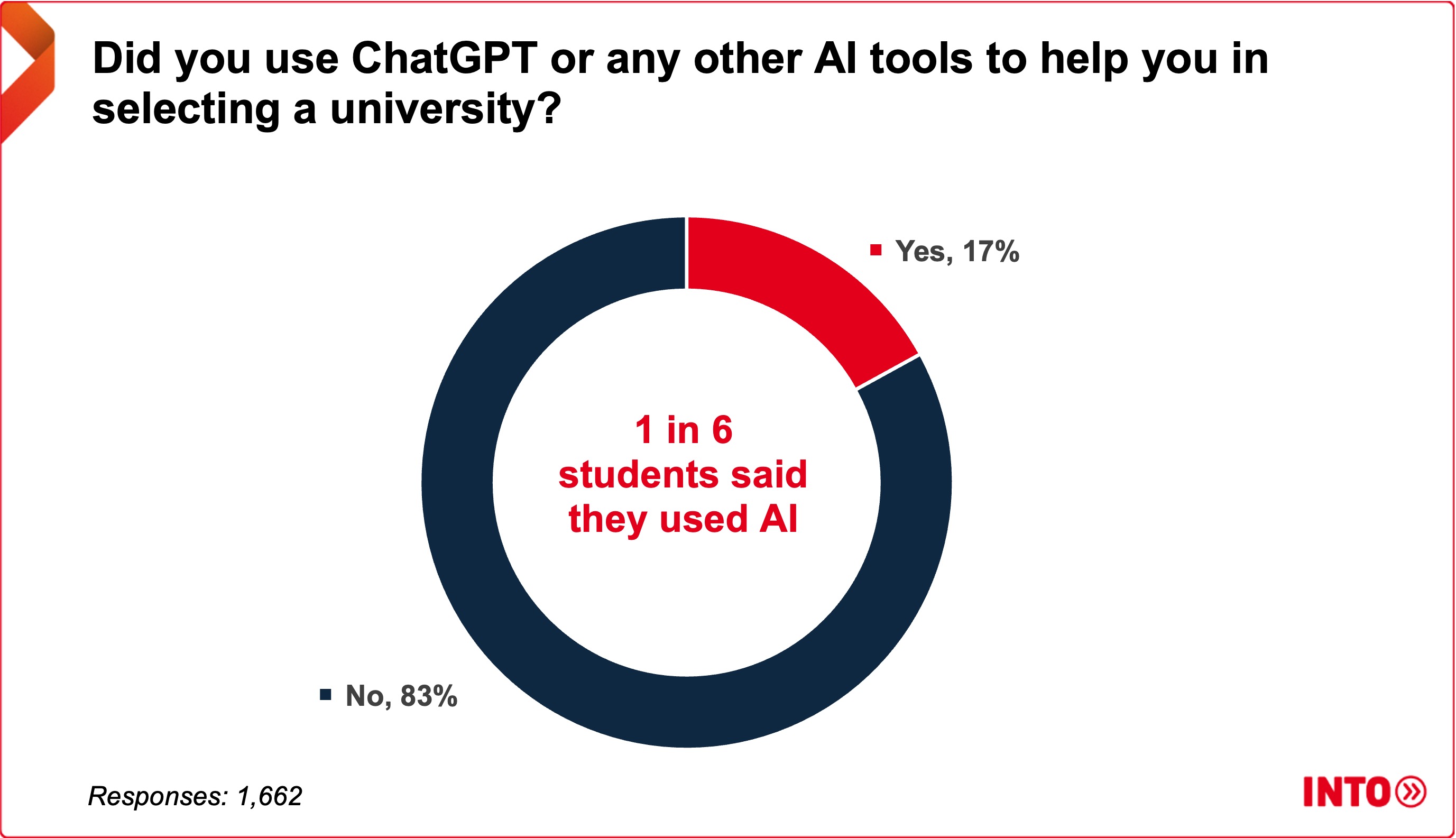
Approximately one in six respondents indicated they used AI (Chat GPT etc) as part of their initial search – but that varies significantly by home country.
The most critical finding however appears to deliver a clear message on the value students ascribe to Large Learning Models (LLMs): 96% of AI users found the guidance they received from AI tools (ChatGPT, etc.) either met or exceeded the quality of information provided by traditional sources (websites, brochures, agents).
This figure—derived from 81% who found AI more helpful and 15% who found it about the same—presents a potentially profound challenge to the legacy digital experience offered by institutions and advisers.
While 17% of newly enrolled students used AI for their search, this 96% endorsement appears to validate the technology as functionally superior for pre-application research. For those who embrace the tool, it has become the standard.
The Context: AI is Already Central to Most University Students
To place the 96% figure into context, it is important to understand that AI is not a novelty for today’s students; for many, it is already an ever-present companion in their academic lives. This survey of 1600 international students simply suggests that recruitment and admissions may simply be the final frontier of adoption.
- Turnitin produced a very useful synthesis of how students use AI. They reveal that an overwhelming majority—86% of students globally—are already regularly using AI in their studies, with 54% using it weekly.
- In the UK, the use of generative AI tools for assessments has seen an explosive increase, with recent reports indicating that 88% to 92% of undergraduates now use AI for their coursework in some capacity.
- According to a HEPI report, Students commonly utilize AI to explain complex concepts, summarise articles, suggest research ideas, and search for information.
- The fact that only 17% of newly enrolled students in this survey reported using AI for their initial university search suggests this phase is the last part of the educational lifecycle to be fully integrated with this standard technology.
The New Asymmetry: East Asia leads the adoption race – for now
While only 17% of newly enrolled students reported using AI for their search, this near-unanimous endorsement within this early-adopting sample (n=1622) suggests that for those who embrace the tool, it is becoming a new standard pre-application research.
Beneath that single number lies a more nuanced adoption story. Usage rates vary sharply by region: nearly 30% of students from South Korea and the Philippines report using AI, along with 28% from Taiwan, 25% from Vietnam and 22% from Japan. Mainland China sits at 21%, while South Asia, Latin America and Africa show more modest uptake.
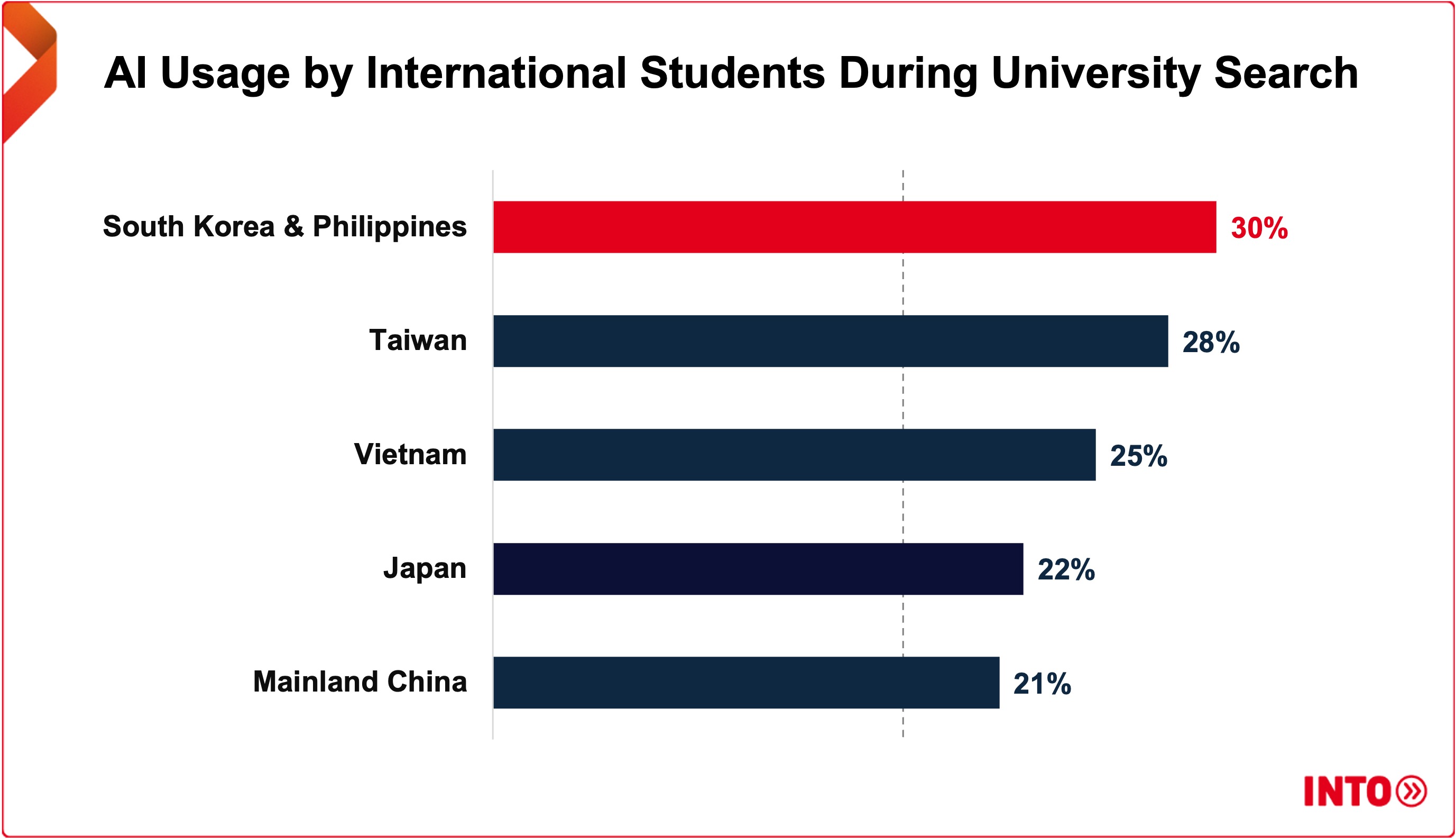
The pattern is probably familiar to those who track technology diffusion: low overall penetration, but pockets of explosive early adoption. These are the indicators of a curve that has yet to reach its inflection point. Most of us working in higher education know that time will come – and sooner than we expect.
The strategic student (and parent) – how students report using AI in their search
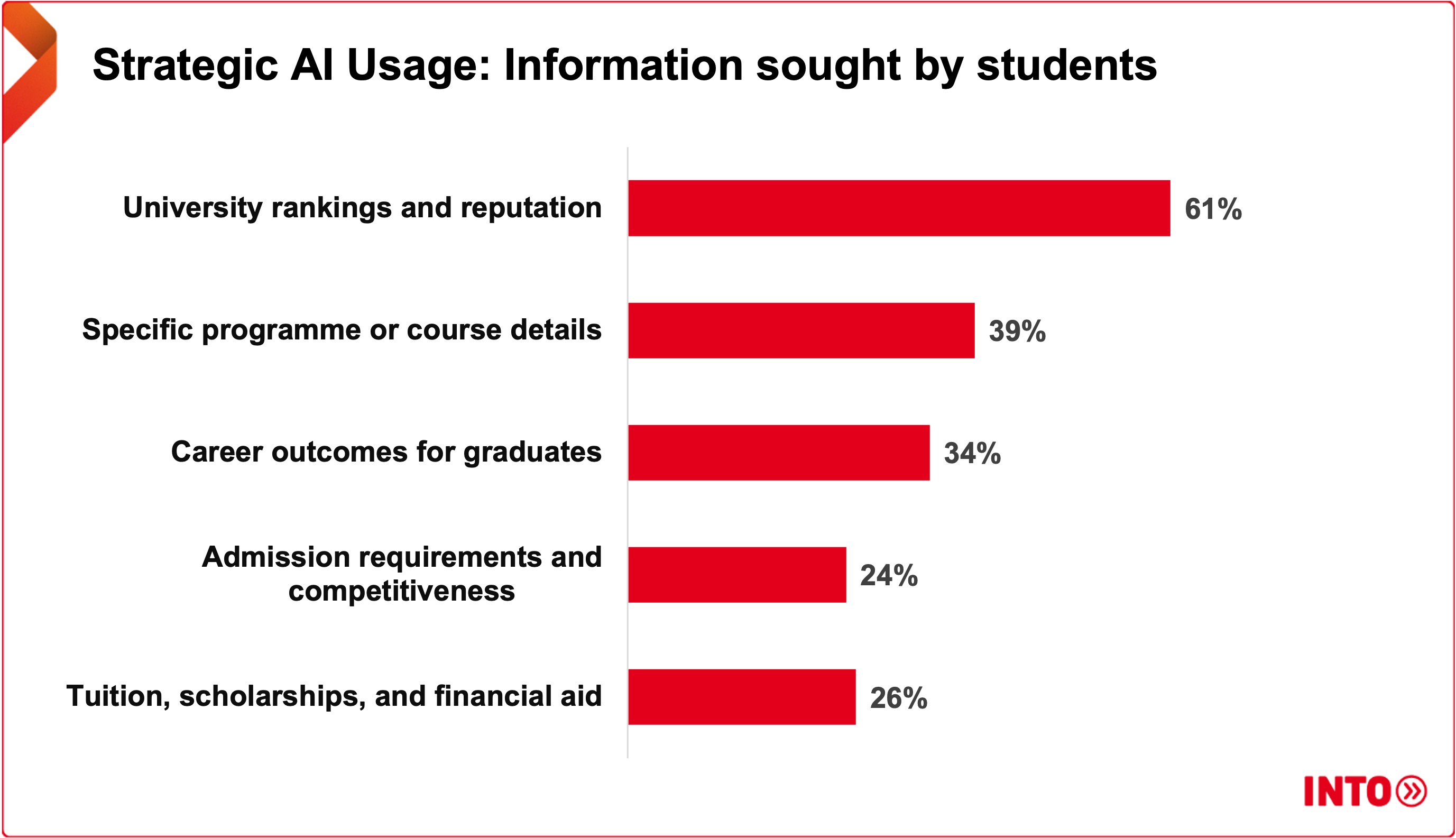
Yet perhaps the more important insight concerns how students are using AI. Far from relying on it for superficial tasks, students are deploying it for strategic decision-making. Among those who used AI during their search:
- 61% asked about university rankings and reputation
- 39% sought programme or course details
- 34% investigated career outcomes
- 34% explored student life
These are not trivialities; they are the structural determinants of a student’s choice – with career outcomes near the top of the search.
The picture that emerges is one in which AI acts as an early-stage adviser—a synthesiser of options, a comparator of institutions and a curator of the overwhelming abundance of online information. Before applicants speak to an agent, attend a webinar or download a prospectus, many have already engaged in a long-form, personalised dialogue with an AI model.
An interesting counterpoint, and one worth emphasising, is that students are discerning in their use of AI for search. They understand where AI is helpful—and where it may be more risky. Only 16% used AI for application essays, and only 17% for visa information. These are domains where inaccuracies can be costly or where plagiarism detection software is sophisticated.
Far from reckless AI adopters, these respondents appear thoughtful and strategic. They are not blindly outsourcing high-stakes decisions; they are using AI precisely where it provides clarity without penalty.
Students value the advice they receive from AI searches.
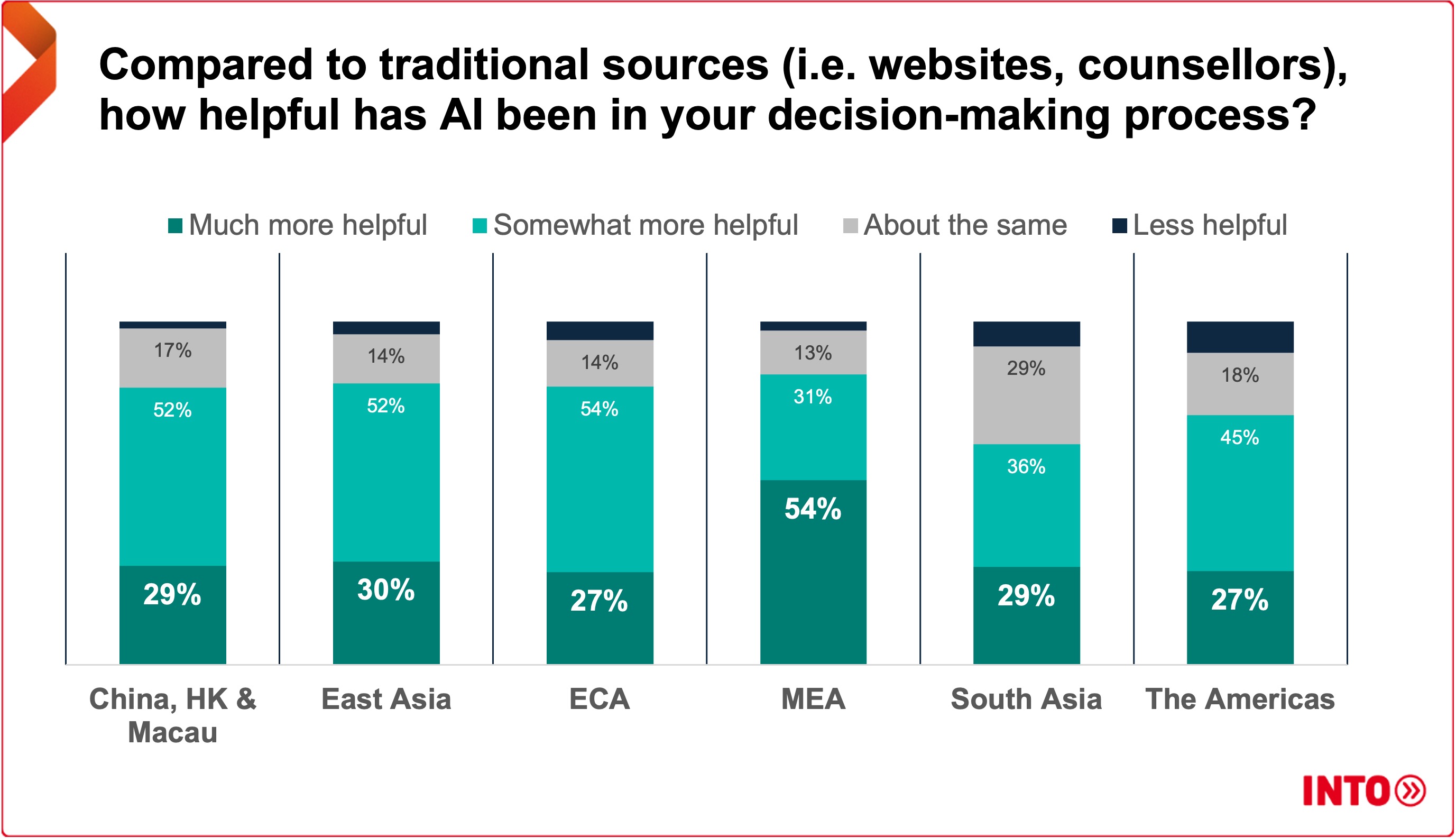
Students (and their parents) are not using AI simply because it is available—they appear to rate the advice highly. When asked to compare AI guidance with university websites, brochures, and even agents, the majority of students indicated the advice was more helpful than traditional sources. This is quietly significant: for many early adopters, AI is already the more effective source.
As AI moves into the top of the recruitment funnel, the first impression of an institution may no longer come from an optimised Google search, but from a generative AI model, (LLM) – Deepseek, Gemini, ChatGPT – take your pick.
It means students are more likely to ask questions in natural language—“Which universities are best for engineering given my budget?”—and receive answers drawn from a diffuse and imperfect online footprint. This means the accuracy, consistency, and clarity of publicly available information has never mattered more. We all know AI gets it wrong – but it is improving.
The implications for the advisory ecosystem of agents, high school counsellors, career coaches and so on are equally profound. AI has begun to take on the foundational advisory tasks—summarising facts and comparing institutions. Agents and counsellors will increasingly be valued not for reciting facts, but for providing emotional context, personalised judgement, and reassurance—things AI still cannot do well.
Meanwhile, students accustomed to personalised, instant AI responses will bring heightened expectations to every subsequent interaction: faster turnaround times, clearer messaging, and communications that feel conversational rather than bureaucratic.
A Mandate for Digital Clarity?
The overwhelming student preference for AI's speed and clarity is a structural challenge that those recruiting or guiding students need to address:
- The New Baseline: For 96% of users, AI either matches or surpasses the information quality of official institutional sources. For a student to choose the official website over AI, the official source must now be unambiguously superior in both information quality and user experience.
- Neutrality is a Challenge: The 15% of users who found AI "about the same" are unlikely to be a neutral group; they are users for whom AI's superior convenience and 24/7 access make it functionally equivalent to a slow, complex official source.
- Regional Contrast: The urgency is pronounced in regions like the Middle East and Africa (MEA), where a majority -54% of users found AI "Much more helpful." Conversely, in South Asia, a higher proportion found AI "about the same" (29%), suggesting that traditional agent networks remain strong and the AI experience has yet to deliver a revolutionary step-change.
- The Critique: With only 4% of users finding AI less helpful, the market will demand speed, clarity, and conversational access, which AI delivers and many institutional systems currently do not.
As AI moves to the top of the recruitment funnel, the first impression is increasingly formed by an LLM synthesis, not a controlled website visit. This means the clarity and consistency of publicly available information has never mattered more.
What Can Universities and Advisors Do Now
Given how students are already using AI—wisely and in growing numbers—we need to act proactively. The following recommendations respond directly to the patterns in our survey data:
1. Optimise content for AI models, not just humans
Clear, structured programme descriptions, updated entry requirements and unambiguous tuition details improve how LLMs summarise your institution.
2. Test how AI currently describes you
Run prompts such as “What is University X known for?” or “Which universities are strongest in Z?”
This reveals inconsistencies or outdated perceptions.
3. Focus on process
Machine learning AI tools can help transform the often arduous application process, delivering a faster, more accurate experience for students and their agents, supporting institutional compliance and smarter monitoring of the conversion/yield funnels.
4. Support advisers to complement, not compete with, AI
Counsellors should focus on interpretation, empathy and nuanced guidance.
5. Publish clear, ethical guidance for applicants
Students are already wary of using AI for essays and visas; universities should reinforce good judgement with transparent policies.
6. Prepare for higher expectations
AI-using applicants arrive better informed and less tolerant of slow, generic or opaque responses.
The challenge is not if AI will reshape the student journey, but how quickly. The data from this survey points to a strong directional shift, validating AI as the preferred functional research tool for a growing segment. The ultimate structure of the recruitment ecosystem, however, is not a fait accomplis; it hinges on the ability of human advisers and institutions to evolve beyond static information delivery and offer value—speed, nuance, and humanity—that AI cannot replicate.